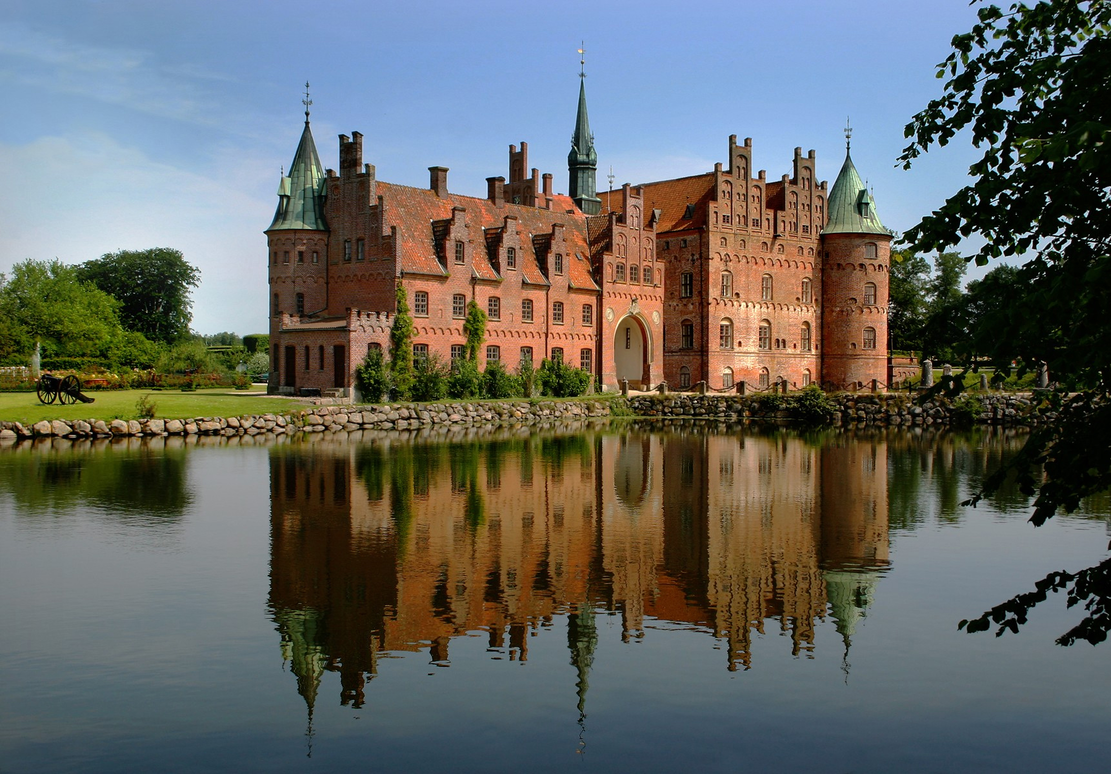
What is a Danish Manor?
In Denmark, there are approximately 730 manor houses, but the exact number depends on how the term is defined.
The concept of a manor house is a historical term tied to a social structure that no longer exists. The Danish Center for Manor Research applies a definition where a farm can only be classified as a manor house if it held this status during a period when the concept was recognized by contemporary society.
Originally, a manor house referred to a farm owned and operated by a lord—typically a nobleman—who usually also resided on the estate. Manor houses held special privileges and were typically associated with tenant farms. After 1660, non-noble individuals could also own a manor house, but a farm was only regarded as such if it already held this status before 1660 or if the king later granted it special rights.
These privileges were gradually phased out, and the last remnants of the manorial special status disappeared in 1908 with the abolition of the tithe.
What made a farm a manor house?
There were no fixed requirements regarding the size of the buildings or the amount of land, but manor houses generally stood out with larger fields and more impressive buildings. However, the smallest manor houses could still be smaller than the largest farms.
On this page, you can find descriptions of the historical development of manor houses and three interactive maps showing where Danish manor houses were located in 1770, 1850, and 1900.
Farms often changed status over time, but the maps only include those that were considered manor houses at the time. There are some borderline cases, which means that a completely definitive list of manor houses is not possible.
For more detailed information, please visit danskeherregaarde.dk, where the Danish Center for Manor Research has compiled descriptions of all Danish manor houses.